A new way to assemble a genome — and it runs on your phone.
Most assemblers build a graph from overlapping reads. Bio-Scry includes a different approach: it treats the genome as a neural field and fits it to your reads, GPU-accelerated end-to-end, entirely on-device.
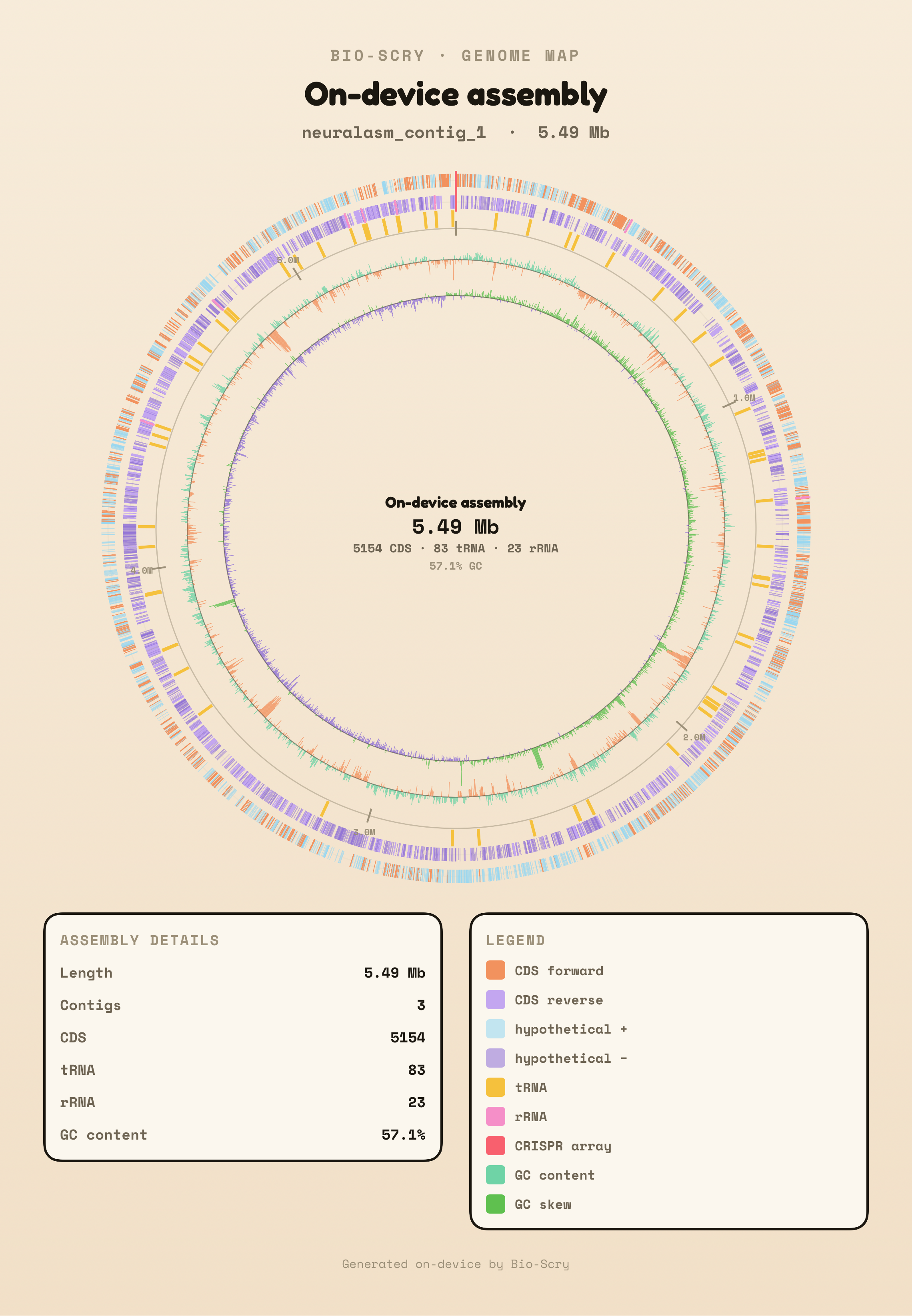
The genome is stored as the weights of a small neural network that maps a coordinate to a base.
The assembler fits that network to your reads and then reads the genome back out of the trained field. It also emits a repeat graph that makes the structure of hard-to-resolve regions explicit.
Represent
The sequence becomes a continuous neural field — a small network whose input is a genomic coordinate and whose output is a base.
Fit
The network is trained to agree with your reads, GPU-accelerated end-to-end on the phone via Apple's Metal — no server, no offload.
Read out
The genome is read back out of the trained field, plus a repeat graph that makes the structure of hard-to-resolve regions explicit.
An honest note on what it is.
The neural-field assembler is offered as a research mode alongside the classic assemblers — a demonstration of a novel method running entirely on consumer hardware. The story here is the novelty and the on-device achievement, not a claim that it is more accurate than established assemblers.
Runs in your pocket
The heaviest steps run on the phone's GPU. No cloud compute, no uploads, no code downloaded at runtime.
A repeat graph
Beyond a linear sequence, it makes the structure of repetitive, hard-to-resolve regions explicit.
Alongside the classics
Use it next to long-read, short-read, hybrid and reference-guided pipelines — all on the same device.